Timeseries‑Driven Trading

Introduction
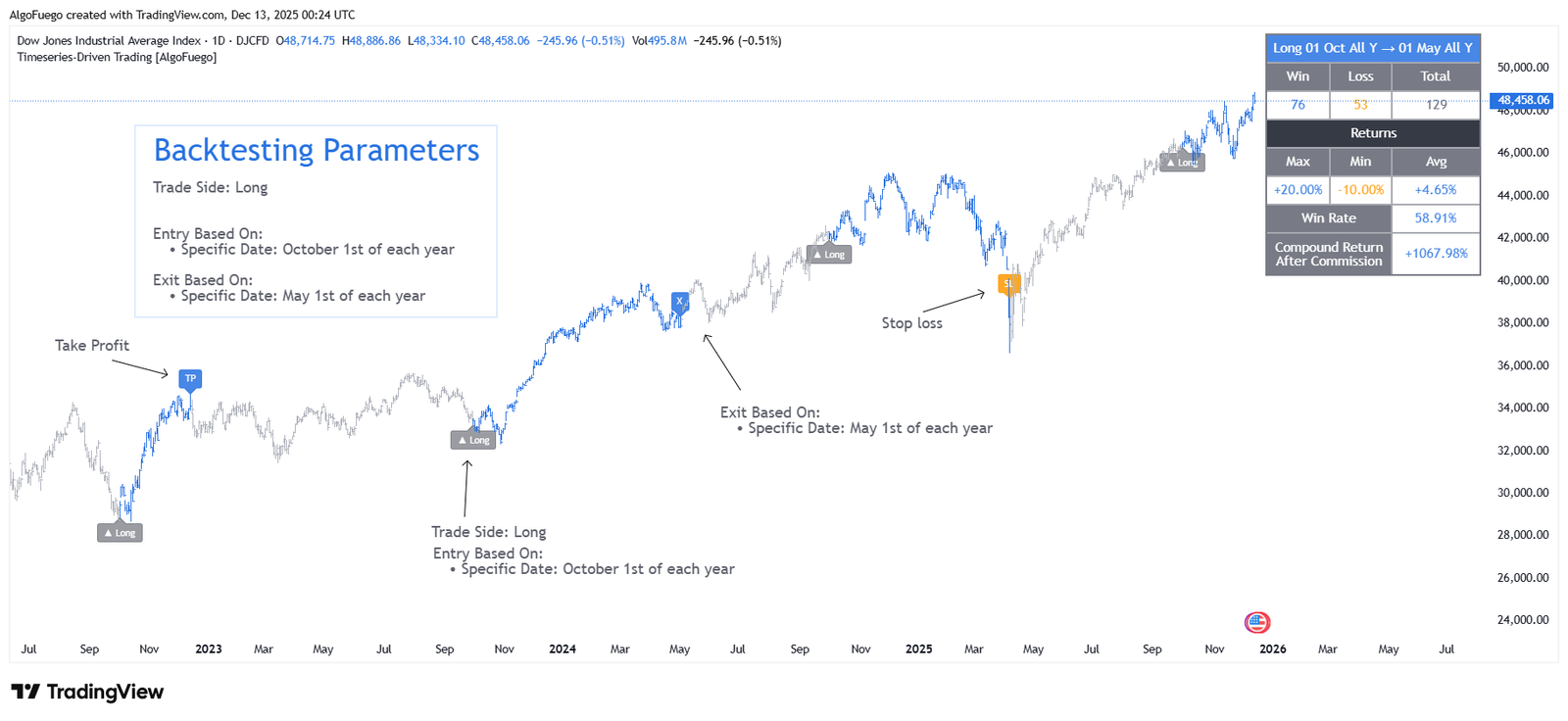
Timeseries‑Driven Trading [AlgoFuego] is a powerful, date‑centric trading engine designed to explore patterns and strategies that are strictly tied to time, calendar behavior, and recurring market cycles. Rather than basing trade decisions solely on price dynamics, TDT emphasizes time‑anchored entry and exit rules that can be ideal for seasonal studies, event‑driven systems, and systematic historical analyses.
Time‑Based Signals That Work on the Calendar, Not Just the Chart
At its core, Timeseries‑Driven Trading is built around a simple yet distinct idea: time itself can be a valid signal generator. Instead of relying on moving averages or oscillators, this indicator allows traders to trigger trades based on specific dates, recurring yearly patterns, or controlled bar counts.
For example, you might use TDT to systematically backtest strategies such as:
-
Seasonal market behaviors around specific calendar dates.
-
Repeatable annual patterns tied to cyclical effects.
-
Event‑related timing strategies where historical dates are used as trade signals.
This makes it an ideal tool for analysts who see markets not just as price graphs, but as time‑series phenomena with embedded rhythms and seasonality.
How the Engine Operates
The TDT indicator integrates several key components to offer a systematic time‑based testing environment:
1. Time‑Based Entry Rules
Trades can be triggered according to:
-
Specific calendar dates — fixed day and month combinations.
-
Relative “current date” behavior — where entries align with present expectations.
-
Year filters — including selections like All, Odd, or Even years to capture recurring cycles over long histories.
This allows traders to build strategies that mimic seasonal, macro, or recurring annual patterns without relying on price pattern recognition alone.
2. Flexible Exit Strategies
Exits can be defined using either:
-
Calendar dates — allowing tight control over when trades close based on the time of year.
-
Bar‑count logic — where a trade is exited after a set number of bars (e.g., days, hours).
This flexibility supports both event‑based holding periods and predefined “time in market” approaches.
-
Backtesting and Risk Management
In addition to time‑based signal generation, the indicator provides a full backtesting framework:
-
Long & Short Simulation — Test how timing logic performs in both directions.
-
Stop‑Loss and Take‑Profit Controls — Apply consistent risk management measures.
-
Commission Modeling — Include realistic costs to better reflect real‑world trading results.
-
Detailed Performance Metrics — Comprehensive statistics such as cumulative returns, win rates, trade counts, and compounded returns are displayed in a performance table.
This combination allows traders to rigorously evaluate time‑based strategies and compare their effectiveness against conventional models.
Visual Tools for Clarity
One of the key strengths of TDT is its visual clarity:
-
Trade Markers on Chart: Entry, exit, stop‑loss, and take‑profit levels appear directly on the price chart.
-
Customizable Labels: Colors and label sizes can be adjusted for readability.
-
Candle Coloring: Bar colors change to reflect trade states (long, short, neutral), aiding visual analysis.
These features make it easy to see when trades were taken, how long they stayed open, and how they performed relative to the chosen time signals.
Who Should Use It?
Timeseries‑Driven Trading is particularly suited for:
-
Traders interested in systematic seasonality and calendar effects.
-
Analysts who want to test hypotheses tied to specific dates or cycles.
-
Quantitative researchers seeking to model strategies that combine timing with disciplined risk controls.
By emphasizing time structure rather than purely price‑action signals, TDT opens the door to alternative systematic strategies that are often overlooked in traditional technical analysis.
A Thoughtful Reminder
While time series and calendar effects can offer fascinating insights, it’s important to remember that market behavior is influenced by a multitude of economic, fundamental, and sentiment‑driven factors that are not captured solely by timing logic. As with any backtesting result, past performance does not guarantee future outcomes. Always practice disciplined risk management and evaluate timing strategies within a broader analytical framework.

19 Dec - 2025

Mo'men Jaradat, Senior Analyst & Market Strategist at AlgoFuego

209

Copy the link

Related Articles
30 Day Free Trial!
Sign up today and start using our premium tools risk-free for 30 days. Get the insights you need to make better trading decisions.